
By James Schneider
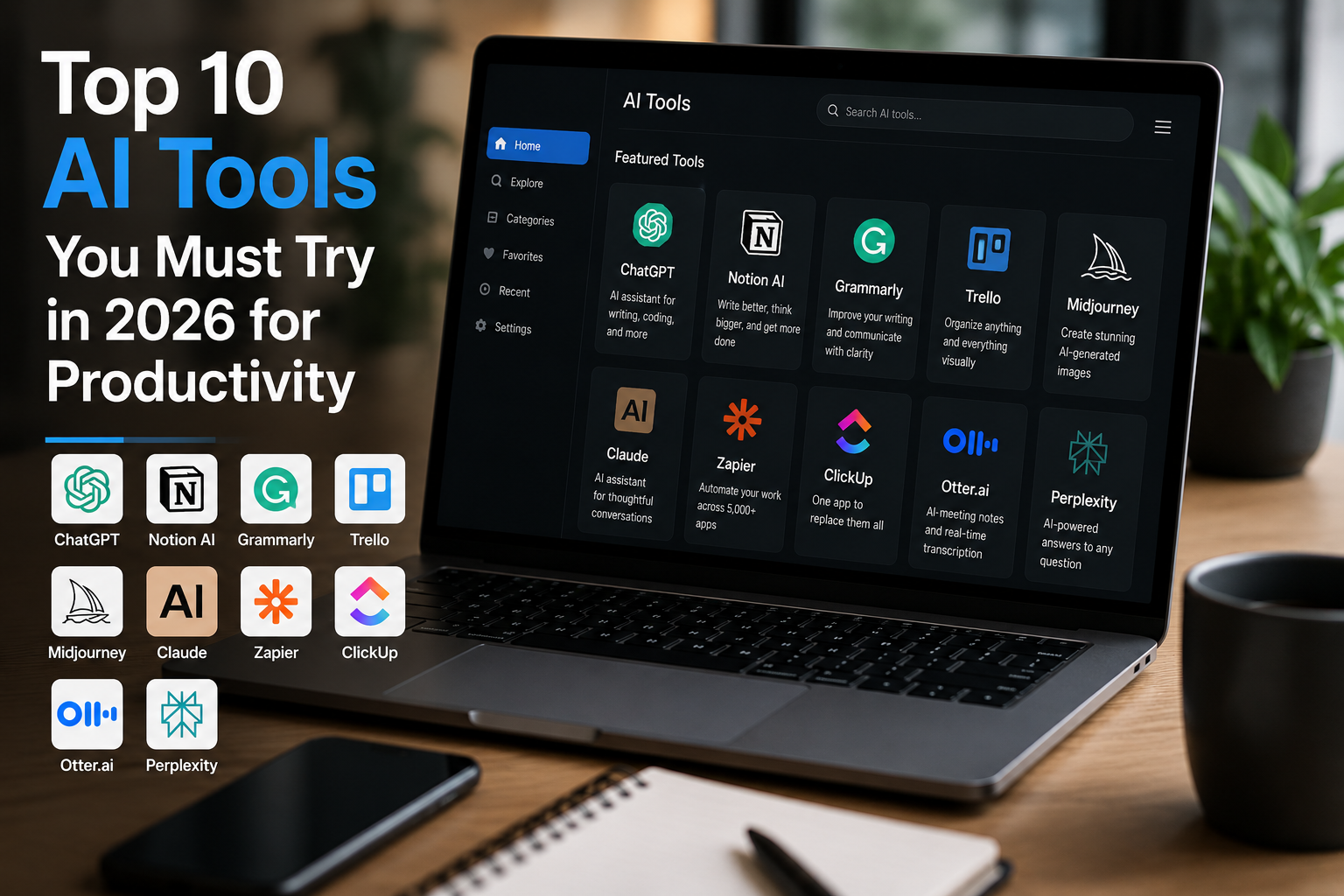
AI isn’t futuristic anymore. It’s here. And if you want to get actual work done—without feeling overwhelmed or replaced—you need tools that make your day shorter and your output better. Here are the top 10 AI tools in 2026 that genuinely help you be more productive, without hype.
Notion AI — Your Second Brain That Actually Thinks With You
I remember the early days of productivity apps. They all felt like digital sticky notes with good intentions. Then I tried Notion AI. Suddenly, my scattered tasks, meeting notes, and random ideas weren’t chaos anymore. Notion AI doesn’t just summarize your text; it understands context. You can ask it to turn a rough scribble into a polished to‑do list. It can rewrite for clarity, extract action items, or even generate meeting agendas when you’re scrambling five minutes before a call.
For me, the real win was emotional labor: I felt less anxiety about forgetting things. It feels like a thoughtful assistant who knows what you meant, even when you didn’t know how to say it.
Grammarly Go — Write Fast, Not Flawed
I’ve been using writing aides for years, and none have saved me as much time as Grammarly Go. But the newer 2026 version feels like someone sitting next to you, whispering the right word at the right time. It corrects grammar, sure—but what I appreciate most is how it adjusts tone. Need professional? Friendly? Stern? It instantly rewrites.
There were days when my brain was mush and deadlines weren’t. Grammarly Go saved my credibility more than once. It doesn’t just fix mistakes; it protects your reputation.
Reclaim AI — Fix Your Calendar Without Fighting It
Calendars are supposed to organize life, but often they just make stress glaringly visible. That’s what I felt before Reclaim AI. It learns your rhythms: when you do deep work best, when you need breaks, when meetings drain you. Then it automatically redistributes your schedule so you actually finish projects instead of just attending meetings.
One day, I woke up and realized that my calendar wasn’t an enemy. It was a partner.
Jasper Chat — Your Creative Partner for When Words Won’t Come
Every writer hits a wall. And every professional—marketer, entrepreneur, student—hits a moment where ideas evaporate. Jasper Chat sits beside you when that happens. It doesn’t just spit generic copy; it pushes back with suggestions, alternatives, and options that feel human. One small prompt can turn into a paragraph that sparks whole sections of my writing. And when it fails? It fails fast, letting me course‑correct without frustration.
I’ve learned that creative work isn’t about being perfect; it’s about getting unstuck. Jasper Chat helps you do that.
Fireflies.ai — The Meeting Note Taker You Actually Trust
We’ve all lived through meetings where someone says, “I’ll take notes,” and then… silence. Fireflies.ai changed that for me. It records, transcribes, and summarizes key points like action items and decisions. But it’s not sterile. It highlights follow‑ups and flags abandoned topics that need revisiting.
My team stopped worrying about remembering every detail. We began trusting that nothing important would disappear into the ether.
Otter.ai — Conversations Turned to Clarity
Similar to Fireflies, but different in energy. Otter.ai feels more conversational. It captures nuance: who said what, where the real questions were, and the parts we always forget five minutes after a conversation. I use Otter when I interview people or collect stories. It turns spoken words into searchable text so you don’t flip through hours of audio.
If you’ve ever felt dread at clicking “record” because you know you’ll have to relive it later, Otter is your relief.
SaneBox — Inbox Zero Without Obsessing Over It
Email—it’s a slow drain on your day. I used to fight it like an enemy. Then I met SaneBox. It quietly filters messages into “must see,” “later,” and “maybe never.” It learns what matters to you and what doesn’t, so your brain isn’t pinged every time something trivial arrives.
Some days, my inbox doesn’t even reach double digits. And the peace of mind? Priceless.
Zapier AI — Automation That Feels Like Magic
I used to believe automation means complex workflows and tech headaches. Zapier AI proved me wrong. You describe what you want in plain language—“When I upload a file here, send this alert there and update this list”—and it builds the workflow for you. No manual step configuring triggers or actions.
It’s like having a tech assistant who actually understands plain English. It saves hours every week and keeps repetitive work off your plate.
Voiceflow — Build Voice and Chat Experiences Without Coding
If your work involves customer support, internal tools, or engagement flows, Voiceflow lets you design AI interactions without coding. When I first explored it, I expected complicated menus and uncertainty. Instead, it was intuitive: you sketch conversations like you’d sketch ideas on paper.
You see how users might respond and how the AI will guide them. It’s less “tech project” and more “conversational design with purpose.” For teams that want to innovate without hiring engineers, this is a game‑changer.
Claude 3 Sonnet — A Thinking Partner, Not Just a Tool
Finally, Claude 3 Sonnet. This is the tool I turn to when the problem is fuzzy and the answer isn’t obvious. It’s not just an editor or summarizer. It reasons with you. I use it for strategy, for refining concepts, and for when the answer has to be precise but feels out of reach. It asks clarifying questions. It weighs options. It helps you arrive somewhere smart, not just somewhere quick.
This feels like the future of productivity: deliberation with speed.
FAQs
Why should I trust AI tools for productivity?
I get it—there’s skepticism. In my years of consulting, I’ve seen trends come and go. What sets these tools apart is not the buzz, but the way they save you mental effort. They handle routine tasks so your brain stays focused on what only you can do: decision‑making, creativity, connection.
Can AI really understand my personal style and preferences?
Yes, but only if you give it room to learn. I’ve found that the first few interactions with any AI tool matter. The more you correct, refine, and guide it, the better it becomes at reflecting your voice and priorities. Think of it as investing in a helper, not outsourcing everything.
Are these tools safe for sensitive company information?
That depends on settings and policies. Many AI tools in 2026 have enterprise options with strong privacy controls. But you should always check how data is stored and who can access it. I treat AI like a partner: helpful, but not careless.
Will AI replace my job if I start using these tools?
AI doesn’t replace people. It replaces inefficiency. When you use it wisely, you become harder to replace because you produce higher‑level work faster and with less burnout. The trick isn’t reliance; it’s skillful use.
How do I choose which of these tools to start with?
Begin with your biggest friction point. If your inbox feels like quicksand, start with SaneBox. If speaking or recording is your challenge, try Otter.ai. The relief you feel when one pain point goes away will motivate you to explore the others.
References
For more insights on how AI empowers productivity in the real world, explore articles on real‑world AI adoption from the MIT Technology Review, practical workflows from Harvard Business Review’s technology section, and user experiences on TechCrunch AI reviews. These resources dive deeper into user case studies, ethical considerations, and the future of work with AI.
Disclaimer
The advice in this article is intended for informational purposes and does not constitute professional recommendations. Your results with specific tools may vary based on individual needs and circumstances.
About James Schneider
James Schneider is a productivity consultant with over two decades of experience helping professionals optimize work with smart tools. He’s worked with startups, Fortune 500 teams, and solo entrepreneurs to streamline workflows without burnout. James writes and speaks about practical tech adoption that respects human intelligence and emotional energy.